




 Catégories produits
Choosing the right speaker cables
Choosing the right speaker cables is often overlooked, yet these connections play an essential role in sound reproduction. A poor-quality or incorrectly sized cable can result in a loss of dynamics, bass attenuation or even distortion, whereas a good speaker cable will preserve all the richness of your music. In this guide, we explain the criteria to consider before purchasing, then offer a comparison of some key products from the Rondson range.
The specific features of a cable
- Conductor: most cables use oxygen-free copper (OFC) for its good conductivity and durability. Some high-end models combine silver and copper to reduce resistance while refining the diameter of the strands, offering a more precise sound.
- Insulation and shielding: the sheath protects the cable from magnetic fields and prevents oxidation of the conductors. The materials (PVC, Teflon, Kapton, etc.) also affect the flexibility and frequency response of the cable.
- Flexibility and shape: a flat or round speaker cable can make it easier to run behind furniture or built-in speakers. It all depends on your setup and the desired mechanical strength.
Different cable cross-sections (0.75 mm², 2.5 mm², 4 mm²)
The impact of changing cable size (0.75 mm², 2.5 mm², 4 mm², etc.) is particularly evident in several key areas of technology. Firstly, the current-carrying capacity varies depending on the cross-section of the cable. A cable with a small cross-section (e.g. 0.75 mm²) can carry much less current than a cable with a larger cross-section (e.g. 2.5 mm² or 4 mm²). Using a cable that is too thin to carry too much current can cause the cable to overheat, leading to malfunctions and safety risks.
Another important factor to consider is voltage drop. This is because the cross-sectional area of the cable has a direct impact on the resistance of the conductor. Thinner cables (e.g. 0.75 mm²) have higher resistance, which results in greater voltage drop, especially over long distances. This can affect the performance of electrical or audio equipment, leading to loss of efficiency or even equipment failure. The flexibility of a cable is also affected by its cross-section.
Thinner cables (e.g. 0.75 mm²) are generally more flexible and easier to handle, making them more suitable for installations requiring mobility and adaptability. On the other hand, cables with larger cross-sections (e.g. 2.5 mm² or 4 mm²) are more rigid and more difficult to install, especially in confined or complex spaces.
In terms of durability, cables with larger cross-sections are generally more robust and able to withstand extreme operating conditions, such as high temperatures or higher voltages. This makes them particularly suitable for industrial installations or systems requiring increased reliability.
Selection criteria
To determine which cable to use for your speakers, there are three main criteria to consider.
First, the conductor cross-section must be suitable for the length of the connection:
For 100 V line: up to 1,500 m, a 2 x 1.5 mm² cable is required; above this, a 2 x 2.5 mm² cable is required
For low impedance: a minimum cable size of 2 x 2.5 mm² is recommended
Next, the quality of the material is important. OFC copper with PVC or Teflon sheathing is always preferable, as it guarantees good conductivity and impeccable durability.
Finally, polarity marking plays a crucial role: a red and black speaker cable with distinct markings simplifies connection and prevents any phase reversal that would affect sound consistency.
Rondson product comparison
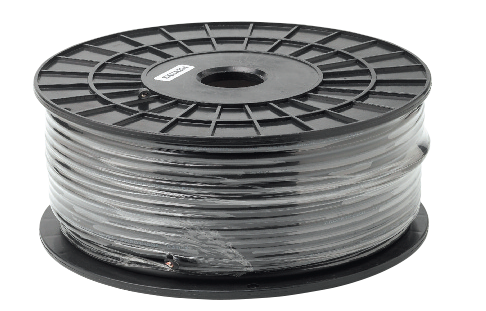
Rondson's range of speaker cables is divided into three main categories: sheathed, unsheathed and shielded, to suit all installation scenarios. Each type meets specific requirements in terms of safety, sound clarity and durability.
Unsheathed cables:
More suitable for protected indoor installations.
|
CAHP-0/75-50M / CAHP-0/075-50M-RN 2×0.75 mm² speaker cable – 50 m reel
|
CAHP-1/5-100M / CAHP-1/5-100M-RN 2×1.5 mm² speaker cable – 100 m reel
|
|
CAHP-2/5-100M / CAHP-2/5-100M-RN 2×2.5 mm² speaker cable – 100 m reel
|
CAHP-4/0-100M / CAHP-4/0-100M-RN 2×4 mm² speaker cable – 100 m reel
|

Câbles avec gaine :
Usage recommandé en extérieur
|
CAHP-2/5-100M / CAHP-2/5-100M-RN 2×1.5 mm² speaker cable – black sheath – 100 m reel
|

Shielded cables:
Preferred in environments with electromagnetic interference
|
2×1.5 mm² speaker cable – shielded – 100 m reel
|
Different use cases depending on the situation
|
Recommended for conference rooms with short distances and moderate power. |
|
Ideal for gyms, combining flexibility and resistance for medium distances. |
|
Ideal for street sound systems where weather resistance and visibility are essential. |
|
Ideal for stadium stands, providing optimal conductivity over long distances. |
|
This cable is designed for sports speakers and large stadiums, ensuring maximum power without loss. |
|
Because it is resistant to electromagnetic interference, it is suitable for conference rooms, gymnasiums and classrooms. |
 CAHP-0/75-100M
An important choice for your setup !
Choosing a cable may seem trivial, but it affects the fidelity and dynamics of your audio system. By considering the criteria of cross-section, material and marking, you will optimise signal transmission between your amplifier and your speakers. To explore the entire range and find the cable that is perfectly suited to your installation, ask yourself the following questions:
- What is the length between my amplifier and my speakers?This determines the required cable cross-section (2.5 mm², 4 mm², etc.) to avoid signal loss.
- Does my installation operate at low impedance or 100 volts? 100 V systems often require thinner cables (e.g. 0.75 mm² to 1.5 mm²), while low impedance requires a larger cross-section.
- How much power will be passing through the cable?The higher the power, the larger the cross-section must be to prevent overheating.
- Do I need a flexible cable for use in conduits or a rigid cable for a fixed installation?This will influence the choice between a flat, round or unshielded cable.
- Is the environment prone to electromagnetic interference or disturbances? If so, a shielded cable is recommended to preserve the audio signal quality.
- Do I need quick visual identification for connections? Red/black cables make connection easy without the risk of polarity reversal.
- Should I prioritise aesthetics or discretion? A black or transparent sheath can be adapted to suit the visual environment (white wall, false ceiling, stage, etc.).
- Is this a fixed or mobile installation? Mobile applications (event sound systems, stage) require more robust cables that are easy to roll up and unroll.
- What is my budget per metre of cable?This will help you decide between thicker sections, shielded or standard cables.
- Is a 50 m or 100 m reel best suited to my current and future needs?Thinking long term will help you avoid breakages or unused cable.
For more information, please contact our experts at contact@rondson.com or REQUEST A QUOTE.