No products available at the moment
Stay tuned! More products will be shown here as they are added.
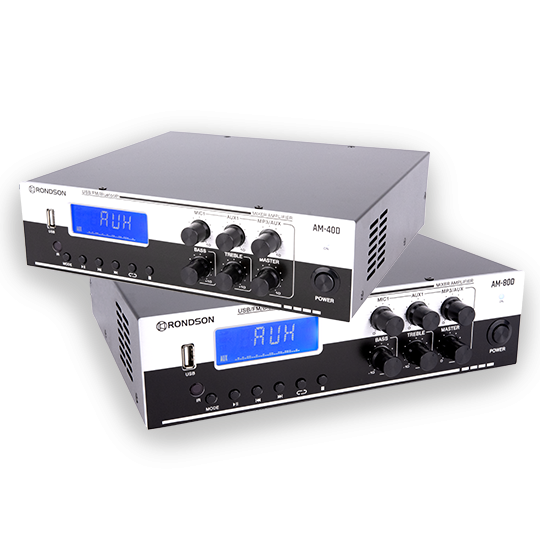
Back to Home pageRondson offers a wide range of mixer amplifiers. Discover our various power levels and functions adapted to the specificities of your Public Address installation.
These amplifiers feature 100 Volt transformers and are also compatible with low-impedance use.
Filter By
Filter By
No products available at the moment
Stay tuned! More products will be shown here as they are added.
Back to Home page
Are you looking for an amp compatible with your installation? A replacement product? A technical recommendation for your project?
Ask your question directly to our AI assistant.
How to calculate the necessary amp power for a 100V line installation?
The power of a 100V line amplifier is calculated according to this simple formula:
Amp power = (Sum of speaker powers) + Margin + Line losses
Detailed calculation steps :
Step 1 : Add the powers of all your speakers
Example : 10 speakers of 5W + 5 speakers of 10W = 100W total
Step 2 : Add a safety margin of 20-30%
100W + 25% = 125W
Step 3 : Integrate losses online (usually 3-5% depending on length)
Recommended final power: 130-135W minimum
Advice :
Always choose an amplifier with a power 30% higher than your calculated needs. This ensures a reserve of dynamics and avoids saturation during sound peaks.
Which section of cable to use for a 100V line installation depending on the distance?
The cable section depends on the power transported and the length of the circuit:
Section/distance reference table:
|
Power |
Distance ≤100m |
Distance 100-200m |
Distance 200-500m |
|
≤ 50W |
1,5 mm² |
2,5 mm² |
4 mm² |
|
50-150W |
2,5 mm² |
4 mm² |
6 mm² |
|
150-300W |
4 mm² |
6 mm² |
10 mm² |
|
>300W |
6 mm² |
10 mm² |
16 mm² |
Essential wiring rules :
Minimize losses: Insufficient cross-section causes voltage drops that reduce the power available to remote enclosures.
Shielded cable recommended: Use shielded audio cable to avoid interference, especially in industrial environments.
Parallel installation: All speakers connect in parallel on the 100V line, unlike low impedance systems.
Points of vigilance :
- Check the linear resistance of your cable (Ω/km)
- Plan margins for future extensions
- Respect the minimum curvature radii
Can we mix speakers of different powers on a 100V line?
Yes, this is one of the main advantages of the 100V line! This flexibility is impossible with traditional low impedance systems.
Advantages of power mixing:
Adaptation by zone :
Total scalability :
- Adding speakers without impedance recalculation
- Modification of individual powers via the transformers
- Gradual extension of the installation
Technical principle :
Each 100V line speaker incorporates a step-down transformer with power selector (2.5W / 5W / 10W / 20W). You individually adjust each diffusion point according to your acoustic needs.
Rules to follow :
1) Total power: The sum must not exceed the power of the amplifier
2) Homogeneous distribution: Avoid excessive power differences between nearby speakers
3) Coverage calculation: Adapt the power to the volume and reverb of each zone
This flexibility makes the 100V line the preferred choice for complex multi-zone installations.
What are the constraints of a 100V line installation outdoors ?
Outdoor installations require specific precautions to ensure reliability and longevity,
Environmental constraints:
Protection against humidity :
- Enclosures with protection rating IP65 minimum (total watertightness)
- IP67 Waterproof Junction Boxes
- Cables with UV sheath and water resistant
Resistance to thermal variations :
- Guaranteed operation from -20°C to +70°C
- Tropicalized components (transformers, electronics)
- Ventilation adapted for the amplifier
Recommended technical solutions :
Tropicalized enclosures :
- UV-treated membrane speakers
- Encapsulated and waterproof transformers
- Stainless grids and supports
Electrical installation :
- Reinforced grounding
- 30mA differential protection mandatory
- Ventilated and heated electrical cabinets
Preventive maintenance :
- Semi-annual monitoring of connections
- Cleaning of speaker grilles
- Verification of the tightness of the housings
What are the different types of 100V line amplifiers and how to choose ?
The 100V line amplifier market offers several configurations depending on the complexity of your installation:
Standard 100V line amplifiers (mono/stereo)
Basic configuration for simple installations :
- 1 to 2 line outputs 100V with fixed power
- Classic audio inputs: XLR, RCA, Jack
- Optimal use: small businesses, offices, warehouses
- Current powers: 30W to 250W
- Advantages: Economical price, ease of use, proven reliability
Multizone 100V line amplifiers,
Independent management of several areas :
- 2 to 8 distinct zones with individual adjustment
- Multiple sources assignable by zone
- Separate volume control for each space
- Announcement priorities with automatic mitigation
Professional applications :
- Shopping malls with separate areas (shops, corridors, parking)
- Multi-space restaurants (room, terrace, bar)
- Hotels (reception, rooms, common areas
Matrix 100V line amplifiers,
High-end solution for complex installations :
- Integrated audio matrix: flexible routing from sources to zones
- Advanced DSP: equalization, delays, zone limiters
- Network management: control via IP, home automation integration
- Redundancy: automatic failover in case of failure